
| 1. Receive the replies · Reliable ingestionAsk your vendor: “How do replies reach you: forwarding, hosted mailbox, or direct inbox access?” |
|---|
| 1. Forwarding address quick start | — | Generate a forwarding address and route replies for processing with no DNS work, suited to simple integrations and testing. |
|---|
| 2. Hosted mailbox + custom domain | Yessubdomain | Dedicated subdomain (e.g., replies.yourcompany.com) with direct delivery, dedicated processing, and alias-based routing (foo@, bar@), no forwarding rules, no relay limitations at high volume. |
|---|
| 3. Industry-standard email authentication | YesCNAME setup | DKIM/CNAME and MX configuration with guided DNS setup, verification, and end-to-end delivery testing to protect against spoofing and phishing. |
|---|
| 2. Sort every reply · Deterministic first, AI reasoning where it countsAsk your vendor: “Do we build rules, or does the system read intent on day one?” |
|---|
| 4. AI reasoning classification | Norules + ML | Replies that need judgment are classified with LLM reasoning, and the model is right-sized per reply, smaller models for simple calls and larger ones for ambiguous replies, saving as many classification credits as possible. |
|---|
| 5. Hybrid deterministic + AI routing | PartialML sorting | Auto-replies and bounces announce what they are in standard email headers, and allGood routes these instantly on the header with no AI call at all, so the bulk of inbox volume processes faster and costs less. |
|---|
| 6. Out-of-the-box categories, ready on day one | Partialhuman vs auto | Pre-configured categories (Unsubscribe, Out of Office, Sales Request, Left Company, Bounce, Spam, Other) work with no setup required. |
|---|
| 7. Custom categories defined in plain English | Nokeyword rules | Admins create or edit categories by writing a plain-English prompt describing the reply type, fully self-service, no vendor ticket or model retraining. |
|---|
| 8. No keyword rules to build or maintain | Norules per phrasing | Replies are classified against plain-English category definitions from the full content (subject, body, metadata), so wording you never predicted still lands in the right category, and there are no keyword rules to write or maintain. |
|---|
| 9. Multi-language classification (58+ languages) | Partialper-language rules | Replies are classified across 58+ languages without language-specific rules. |
|---|
| 3. Mine and enrich contacts · AI-reasoned enrichmentAsk your vendor: “If the reply doesn't contain the data, can the system still find and verify it?” |
|---|
| 10. Configurable extraction fields per category | Partialfixed fields | Define fields to pull from matched emails (replacement contact, email signature details, return date, new email address) with plain-English descriptions; unlimited fields per category. |
|---|
| 11. First-party enrichment from reply content | Yesmined contacts | Replacement contacts, new email addresses, and return dates extracted from left-company and out-of-office replies and written back to the MAP, the database stays current as campaigns run. |
|---|
| 12. Multi-provider waterfall enrichment | Noreply data only | Taps multiple data providers in sequence, ranks responses by quality, and chooses the most accurate match, going beyond what is inside the email itself. |
|---|
| 13. AI validation of provider responses | Nono providers | Provider responses are checked with AI validation; false positives are rejected and enrichment retries until an accurate match is found, bad data never enters the database. |
|---|
| 14. Sparse-lead recovery | Nosignature only | Partial records (e.g., just a name and a company) are enough, cross-references LinkedIn and the web to recover leads other tools give up on. |
|---|
| 4. Look up the contact before acting · CRM-grounded decisionsAsk your vendor: “Can the system pull fields from our MAP into the decision before an action fires?” |
|---|
| 15. CRM/MAP data fetchers before actions run | Partiallead owner only | Pull lead owner, lifecycle stage, or any Marketo field into the workflow before actions execute, so decisions use CRM context as well as email content. |
|---|
| 16. Conditional fetch logic | Nono conditions | Fetch external data only when conditions are met (e.g., subject equals ‘I’m Interested’), avoiding unnecessary API calls against MAP rate limits. |
|---|
| 17. Configurable lead-not-found behavior | — | Choose per fetcher: continue processing with empty data, or stop and flag for review when the lead is not in the MAP. |
|---|
| 5. Route and act on the reply · Agentic actionsAsk your vendor: “What can actually happen after categorization, beyond a forward and a field sync?” |
|---|
| 18. Forward email with full control | YesRoute and Track | Forward classified replies with configurable recipient, subject, message, CC, reply-to, from-name, and original email handling (quoted, inline, or excluded). |
|---|
| 19. Sync lead fields to MAP | YesUpdate Contacts | Update one or many MAP lead fields per classification, with static values or dynamic variables (classification, rationale, extracted fields). |
|---|
| 20. Create/Update leads sync modes | — | Per action, choose Create or Update, Create Only, or Update Only, with skip-if-not-found handling for update-only mode. |
|---|
| 21. Add lead to MAP static list | — | Add classified leads to a target static list by MAP list ID or URL (e.g., suppression or routing lists). |
|---|
| 22. Trigger a Marketo campaign from a reply | — | Request Campaign action fires a Marketo campaign for the classified lead, replies flow directly into MAP orchestration. |
|---|
| 23. HubSpot actions | YesHubSpot sync | Sync classified replies and extracted data to HubSpot. |
|---|
| 24. Eloqua actions | YesEloqua sync | Sync classified replies and extracted data to Eloqua. |
|---|
| 25. Chain replies into broader workflows | Noends at sync | Add to Worksheet action pushes a classified reply (with all fields and rationale) into any other allGood workflow and can trigger that workflow automatically, reply management extends into the full agentic platform. |
|---|
| 26. Conditional logic on actions | — | Sync, static list, campaign, and worksheet actions support ‘only runs if’ conditions (e.g., only sync if classification equals ‘interested’). |
|---|
| 6. Stop for human review · Human-in-the-loopAsk your vendor: “What happens when the AI can't find a required field? Does it act anyway?” |
|---|
| 27. Required-field enforcement with human review | Nono review step | Fields marked Required for Marketo/HubSpot/Eloqua/Salesforce update halt automation when missing, the item is flagged for manual review instead of being processed with incomplete data. |
|---|
| 28. Explicit Save & Publish workflow | — | Configuration changes are drafted and only go live on publish, no accidental changes to live traffic handling. |
|---|
| 7. See every decision, and why · ExplainabilityAsk your vendor: “For any specific reply, can you show us why it was categorized that way?” |
|---|
| 29. Plain-English rationale for every classification | Nomatched rule only | Every processed email carries an explanation of why it was classified that way, visible in the UI and usable as a variable in downstream actions. |
|---|
| 30. Messages view with per-email reasoning | Partialreply log | Inspect every reply the system has handled and why it was classified the way it was. |
|---|
| 31. Search and debug across all replies | — | Find specific emails across every category and field for debugging and audit. |
|---|
| 8. Test before anything goes live · Evals before productionAsk your vendor: “Can we run a regression suite against our own replies before a change goes live?” |
|---|
| 32. Built-in test suite for reply workflows | Nono test suite | A QA layer validates categorizations and field extractions against your own replies before anything runs against live inbound mail. |
|---|
| 33. Baseline tests shipped for out-of-the-box categories | No | Every workspace includes a baseline suite covering out-of-the-box categorizations from day one. |
|---|
| 34. Custom test cases from real replies | No | Build tests with full control of body, sender, recipient, alias, and subject, mirroring production inputs including signatures and quoted threads. |
|---|
| 35. Assertions on category and extracted fields | No | Tests assert the expected category, and one check per extracted field validates the value the model returns. No writes to your MAP are needed, so testing never touches production data. |
|---|
| 36. Exact and semantic comparison types | No | Field checks match verbatim (dates, statuses) or on meaning (free-text reasons the model may paraphrase). |
|---|
| 37. One-click regression runs | No | Run the full suite after any prompt or model change to surface regressions in previously passing categorizations, before publishing. |
|---|
| 38. Per-test debug and pass/fail tracking | No | Click into any test to edit, rerun, debug, and delete; filter the suite by status or categorization. |
|---|
| 9. Migrate from Drift Email · Agentic migrationAsk your vendor: “Will our team rebuild our skills by hand, or can you read our existing setup?” |
|---|
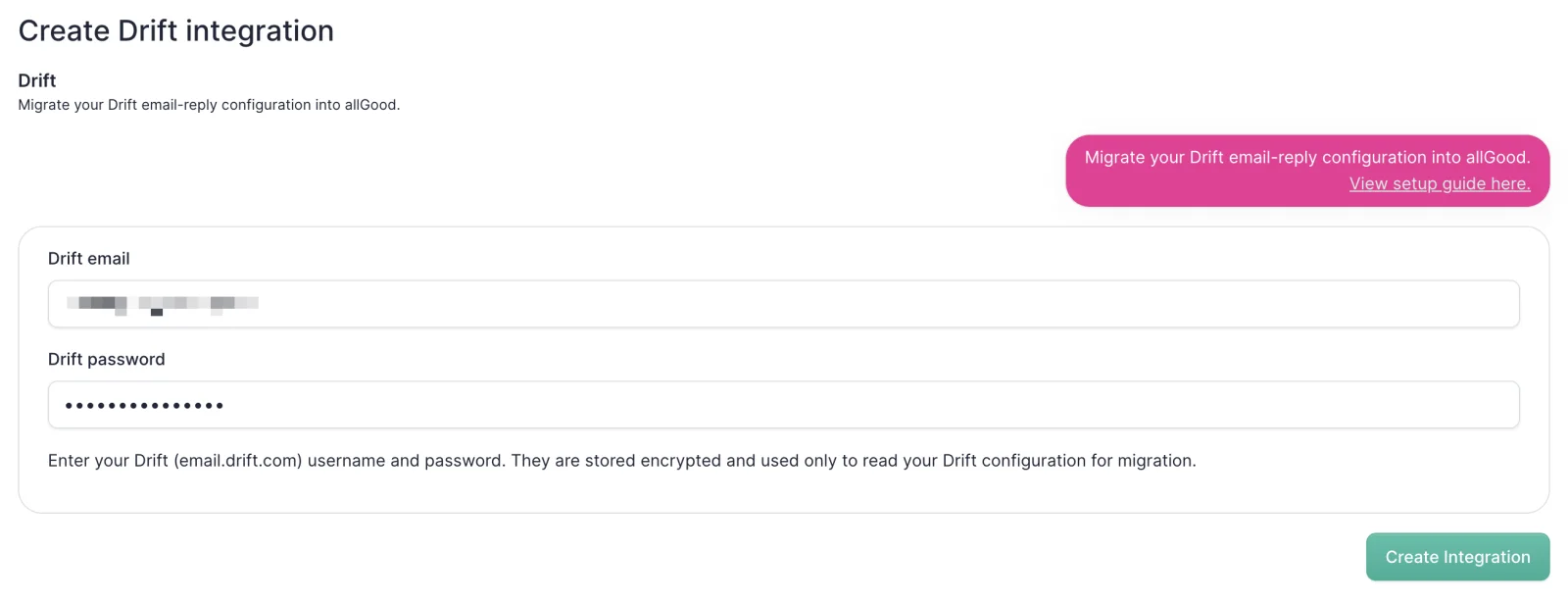
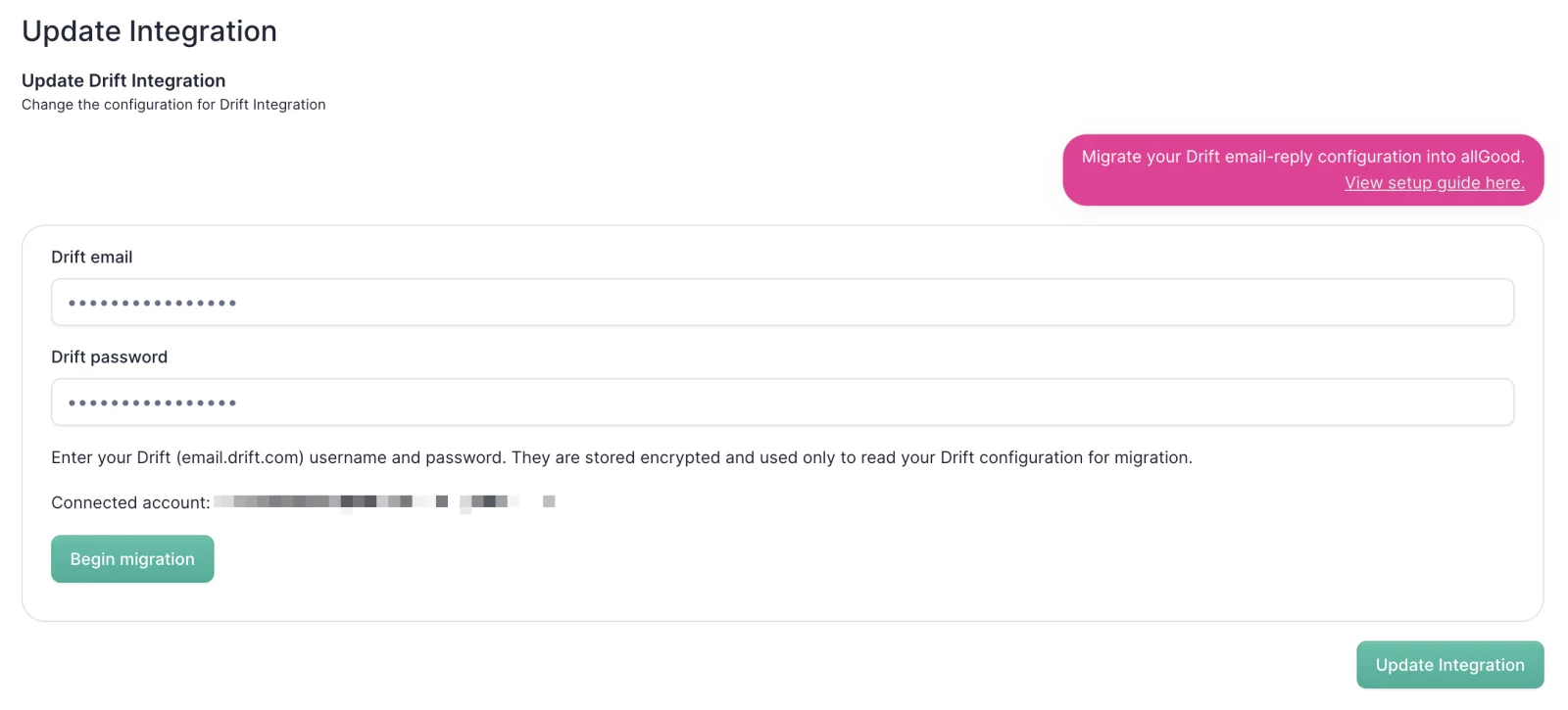
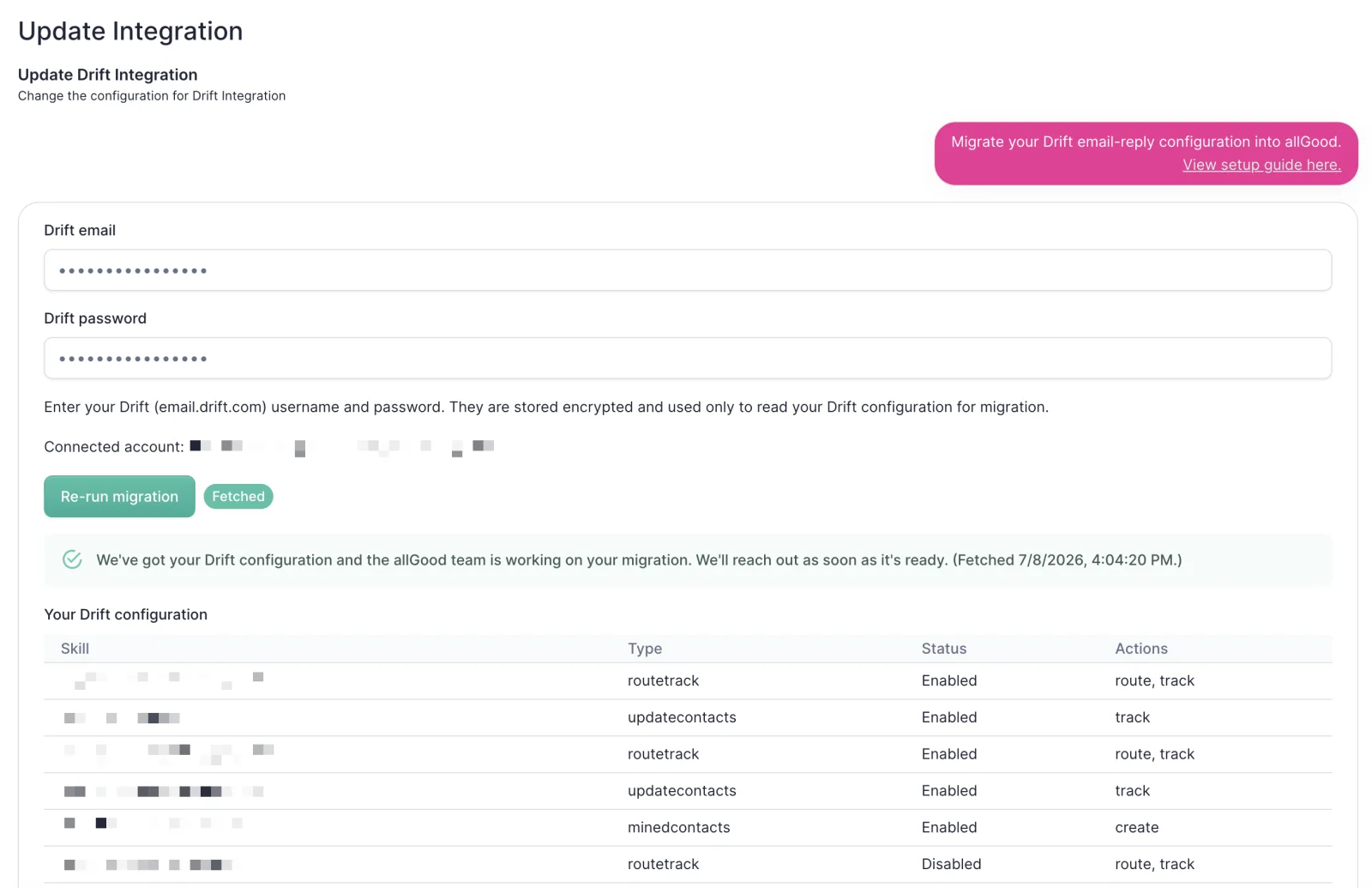
| 39. Automated Drift Email configuration migration | — | Reads your existing Drift Email configuration and recreates every skill, route, and action as a reasoning system, no exporting rules, mapping fields, or re-entering anything. Minutes. |
|---|
| 40. Migration summary and validation before go-live | — | Every migrated skill is listed with its type, enabled state, and actions; validate against real replies with the built-in test suite before anything goes live. |
|---|
| 41. Read-only, encrypted access to legacy config | — | Migration connects to the legacy tool with encrypted, read-only access, nothing in the source system is modified. |
|---|
| 10. Enterprise readiness · Security you can inspectAsk your vendor: “Where is the security documentation, and what exactly can the system access?” |
|---|
| 42. SSO with enterprise IdP and domain verification | — | Configure your enterprise identity provider and verify domain ownership. |
|---|
| 43. Users, roles, and access control | — | Invite the team and configure roles and permissions. |
|---|
| 44. Credential encryption and access controls | — | Integration credentials encrypted with AWS KMS (AES-256), TLS 1.2+ in transit, MFA-gated access limited to authorized personnel. |
|---|
| 45. SOC 2 Type II and GDPR compliance | — | SOC 2 Type II certified, GDPR compliant, encrypted in transit and at rest; connects only to sending inboxes with scoped access; data deleted within 60 days of leaving. |
|---|