

allGood is a reasoning-based classifier, and the clearer your category definitions are, the easier it is for it to classify emails exactly the way you intend. Below are three principles to keep in mind when writing the prompts for your categories.
1. Every category should be clearly distinct from the others
One of the most common classification mistakes is an email landing in a category adjacent to the intended one. If two categories overlap and the prompts don't make clear where the line is, allGood will draw it itself, and its judgment won't always match yours.
Here's an example. The distinction between Changed Email and Left Company has a natural grey area: an email from someone who has left the company but provides their own personal or new-company address as the forwarding contact. Depending on what you do with that information downstream (for example, creating a new contact in your MAP) you may want these handled very differently.
The prompts below work well because they split the grey area explicitly, leaving no overlap. Each one names the boundary case and tells allGood which side it belongs on:
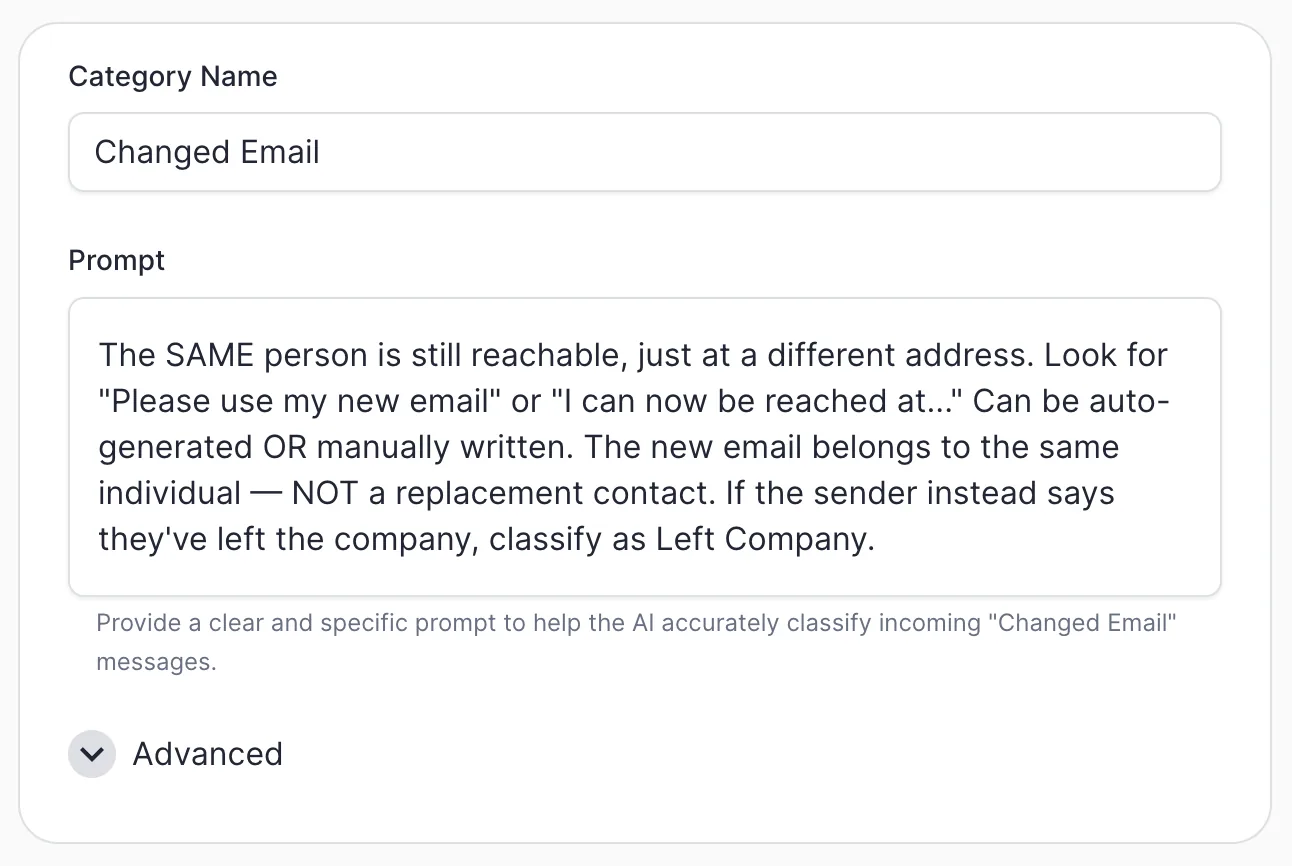
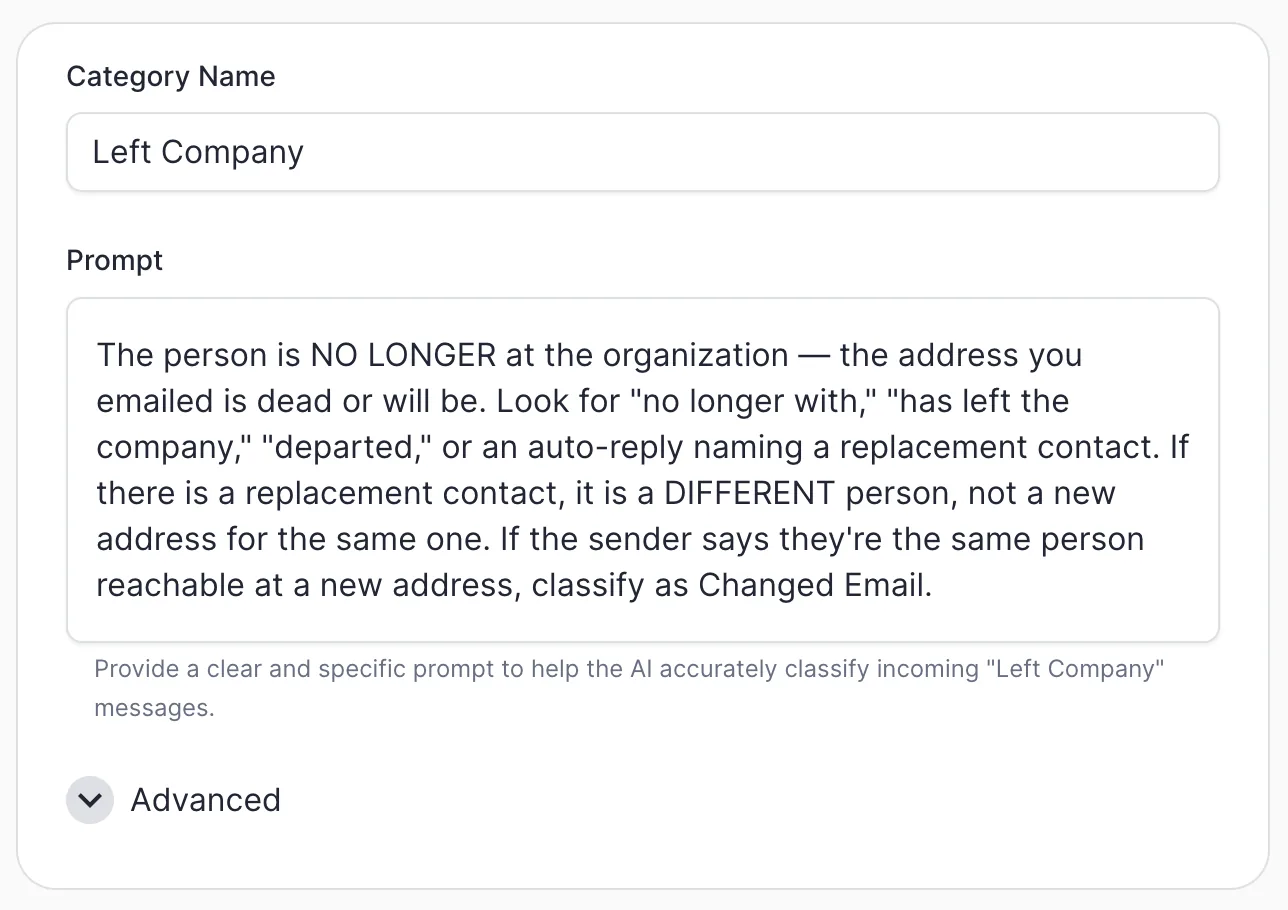
Notice that each prompt references the other and states a tiebreaker. That cross-reference is what eliminates the grey area: no matter which category allGood considers first, the prompt tells it exactly when to hand off to the other one.
2. Write definitions with the action in mind
Categories exist to drive actions. Keeping the downstream action in mind while writing a definition lets you build in exactly the requirements that action needs.
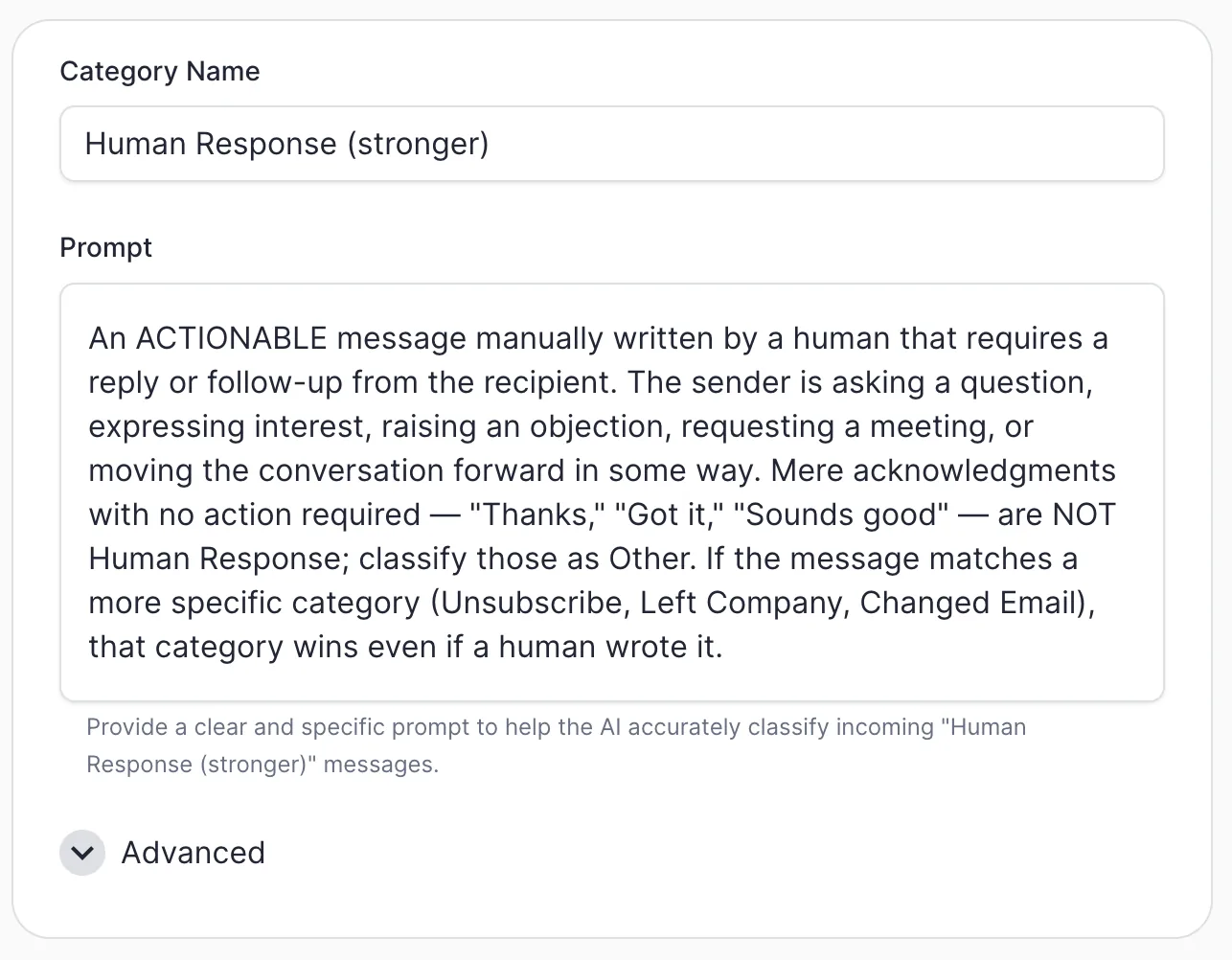
Compare these two prompts for Human Response:
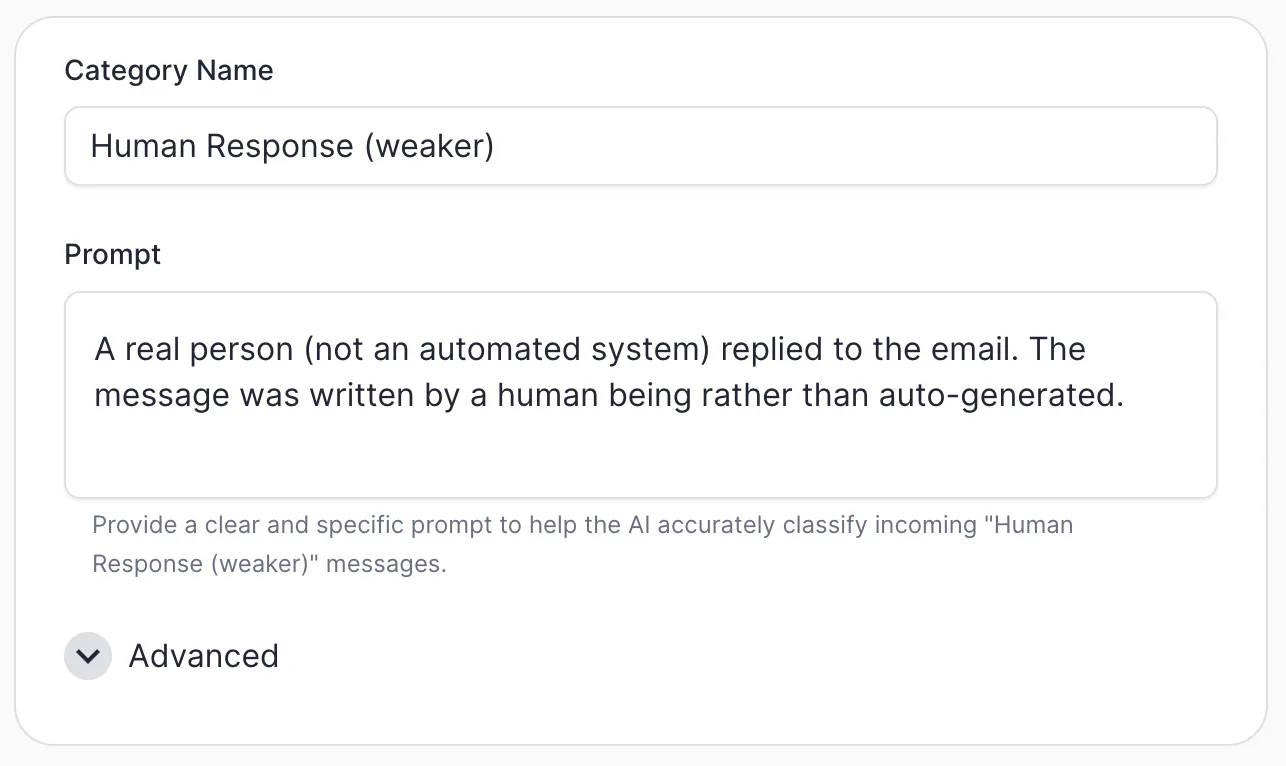
The first prompt only describes authorship: a human wrote it. That's a property of the message, not a routing decision. Under that prompt, "Thanks!" and "Yes, I'd love a demo, does Thursday work?" classify identically.
The second prompt is much better when the action is forwarding to an inbox that only wants actionable items. Human replies that require no follow-up would just be extra noise there, so the prompt adds an actionability requirement, gives concrete examples of what counts, and states that more specific categories take precedence.
3. If a category requires very specific wording, anchor it with concrete signal phrases
ERM is a reasoning-based system, not a rules-based one, but that doesn't mean you can't be specific. If a category hinges on a particular kind of wording, there's no harm in telling allGood exactly what phrases should trigger it. The reasoning layer still handles novel phrasings and other languages; the signal phrases simply guarantee the known ones never slip through.
A good example is a category for privacy-law requests, where missing a legitimate request has real compliance consequences:
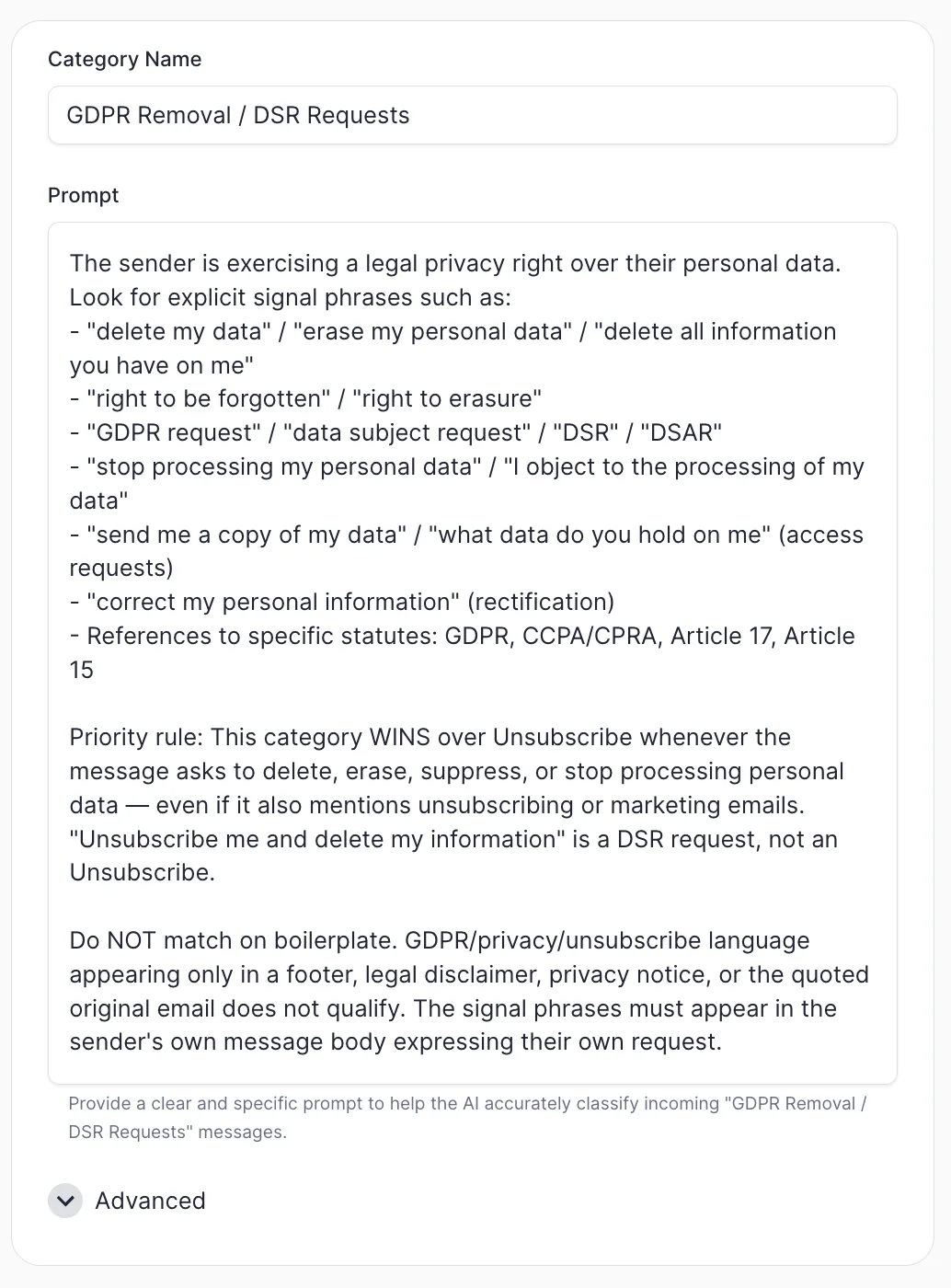
This prompt works because the phrases are listed as concrete things to scan for, the priority rule is illustrated with a worked example, and the boilerplate exclusion prevents false positives from footers and disclaimers.
Wrapping up
Clear category definitions are the highest-leverage improvement you can make to classification quality. To summarize: eliminate overlap between categories and state explicit tiebreakers, write each definition around the action it drives, and anchor wording-specific categories with concrete signal phrases.
Finally, remember that writing prompts is an iterative process. Don't expect to get them perfect on the first pass. Write, test against real emails, see where classifications drift from what you expected, and update the prompts to close those gaps. Then repeat. Each cycle sharpens the boundaries a little more, and you keep going until allGood is classifying exactly the way you would. allGood handles the reasoning; your job is to make sure it's reasoning toward the same answer you would.